
Ages 3-8
Perfect for preschoolers and early elementary. Older children can benefit too!

Have an account? Log in to check out faster.
Everything you need to know about The Bee A Time Keeper® clock, from how it works to shipping, returns and more. If you don't see your question here, we're always happy to help!
The most common questions at a glance.
Perfect for preschoolers and early elementary. Older children can benefit too!

Children simply follow the Bee and Snail to understand what comes next.

No ticking. No distracting second hand. A calmer, more focused experience for children.
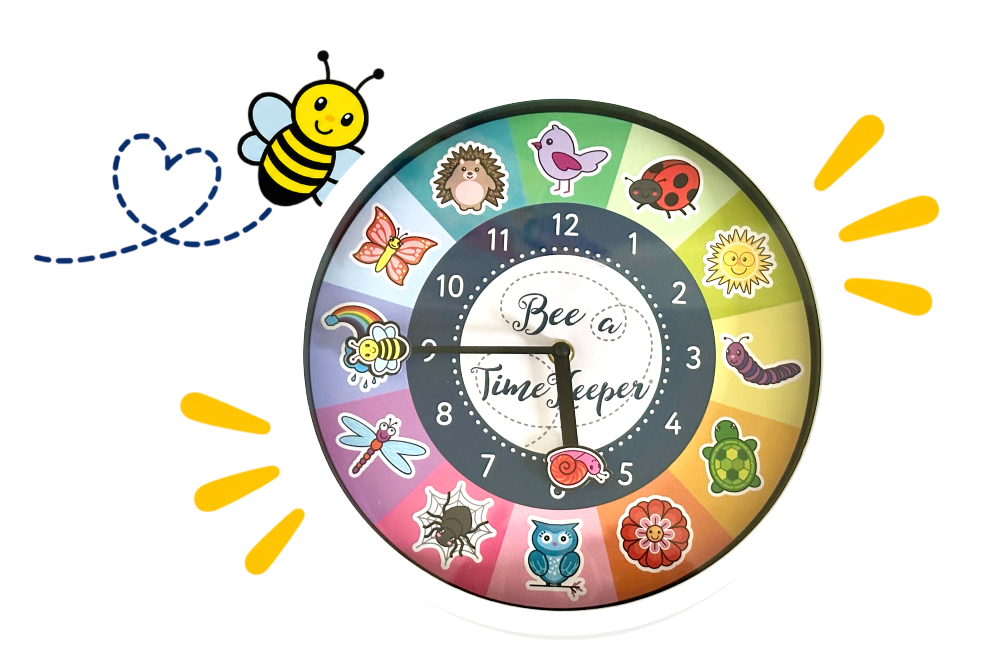
The Bee A Time Keeper® Clock turns time into a clear visual that young children can actually see and understand. Instead of numbers or digital countdowns, kids watch the playful Bee (minutes) and Snail (hours) move toward familiar critter character targets, helping them anticipate what’s next and navigate transitions with less stress.
Children learn naturally using child friendly critters and learning time language. The clock’s analog format shows what time has passed, what is happening now, and what is coming up next. This helps children develop true time awareness and better understand what “5 more minutes” looks and feels like.
Analog clocks are a visual representation of time and help anyone understand the past, present, and Future time while digital clocks only show Now time. This foundational skill supports lifelong time-management and planning, and is strongly recommended by executive-function experts like Marydee Sklar, author of Seeing My Time®.
Great question! After teaching the child about the concept of fast and slow, introduce the Bee (moves fast – is the minute hand) and the Snail (moves slow – is the hour hand). This simple pairing helps children to see how time moves.
Absolutely! this is one of its biggest benefits.
Parents and teachers report fewer meltdowns, smoother transitions, and more predictable routines because children can see how much time is left before the next activity.

We do not offer free shipping at this time. All orders are shipped through USPS, and shipping costs are calculated at checkout based on your zip code and the number of clocks purchased. This ensures you only pay the actual USPS rate for your order.
If you need to change or cancel your order, please email us at BeeATimeKeeper@gmail.com as soon as possible. Once an order is processed or shipped, we are unable to make changes or cancel it.
Email: BeeATimeKeeper@gmail.com
Please include your order number in your message.
We want you to love your Bee A Time Keeper® clock!
• If your clock arrives damaged or defective, please email us within 7 days of delivery with photos, and we’ll work with you to make it right.
• Returns for non-damaged items may be accepted within 14 days of delivery if the clock is unused, in original packaging, and in resellable condition.
• Customers are responsible for return shipping unless the item arrived damaged.
• We are unable to accept returns for items that show signs of use or are reported beyond the stated return window.
Email: BeeATimeKeeper@gmail.com
Customers are responsible for return shipping costs unless the item arrived damaged or defective upon delivery.
Please review our returns policy for eligibility, timeframes, and instructions.
We love supporting schools, nonprofits, therapy centers, clinics, and organizations working with children. Bulk pricing or institutional discounts may be available on clock purchases only (shipping is not discounted and will be charged separately based on USPS rates). Availability may vary depending on quantity and location.
If you’re interested in bulk or institutional pricing, please email us with the following information so we can best assist you:
• Organization name (school, therapy center, clinic, or nonprofit)
• Quantity needed
• Shipping location
• Contact person
Email: BeeATimeKeeper@gmail.com
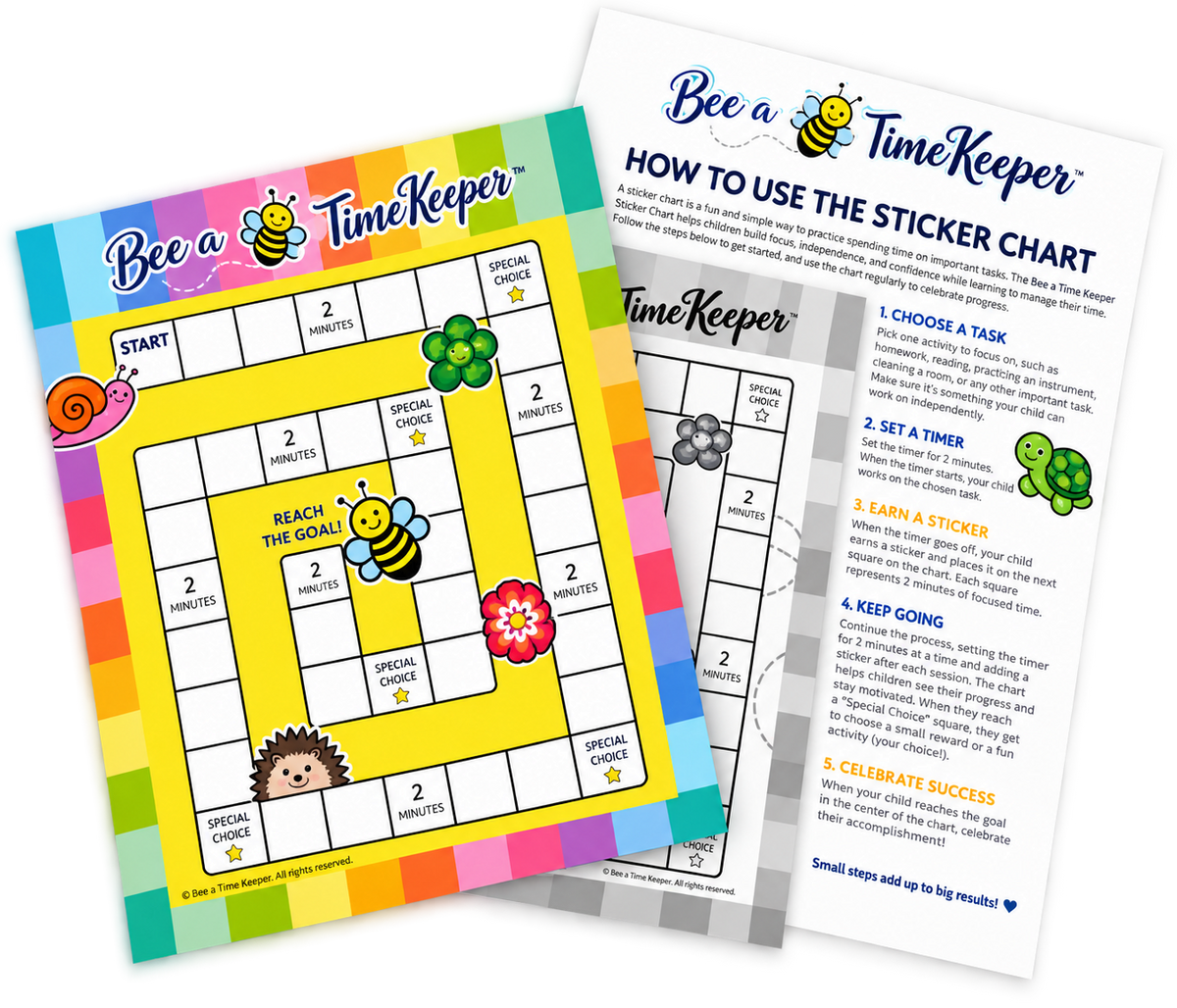
Sign up for our newsletter and receive your free sticker chart.
